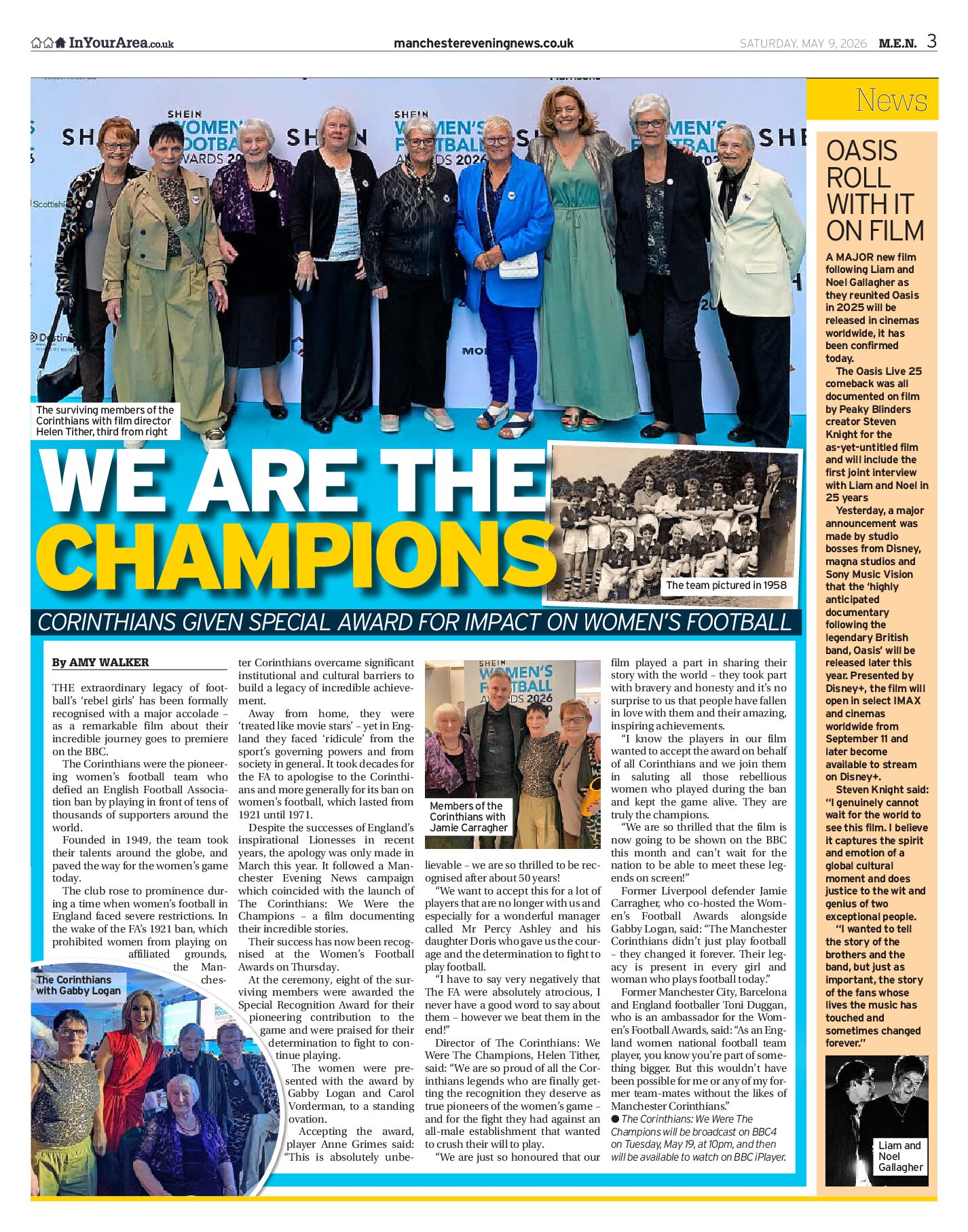

The Manchester Evening News launched a successful campaign calling on the Football Association to apologise for its historic treatment of the Manchester Corinthians, a pioneering women’s football team whose players became known as the “Manchester Suffragettes”.
The campaign shone a spotlight on the extraordinary story of the Manchester Corinthians, who continued to play despite the FA’s 50-year ban on women’s football between 1921 and 1971. Denied official recognition and told that football was “unsuitable” for women, the team defied restrictions to compete across Europe and South America, becoming trailblazers for future generations of women footballers.
Working alongside documentary maker Helen Tither, whose film Manchester Corinthians: We Were the Champions told the team’s story, the Manchester Evening News launched a petition and campaign urging the FA to formally acknowledge the injustice the players faced. The campaign quickly gained support from surviving players, community leaders and then Greater Manchester Mayor Andy Burnham.
In a significant victory, the FA issued a public apology, recognising the Manchester Corinthians as pioneers of women’s football and expressing regret for the ban that excluded generations of female players. In its statement, the FA said: “We are sorry that a ban on women’s football was introduced in 1921 and not revoked until 1971. We recognise the courage of the teams and individuals who continued to play the game during this period.”
The campaign’s impact was praised by Manchester Evening News editor-in-chief Sarah Lester, who said: “We worked with Helen to launch a campaign, and petition, to ask the FA to apologise. To our surprise we won the campaign in less than a week.
“Too often in history the voices of women have not been heard. I am delighted that the Manchester Corinthians have finally received the apology they deserve.
“People sometimes question whether moments like this matter, but you only have to hear what it means to these women to understand how significant it is and the message it sends. Helen Tither’s film, inspired by our chief reporter Neal Keeling’s original reporting, brought this story to life in a powerful way. One of the most striking things was that the FA had never apologised, and that is something we wanted to change.
“These women faced ridicule and, in some cases, felt they had to keep their football a secret. Had they been men, they would have been celebrated as heroes. It has taken far too long, but this campaign has helped apply the pressure needed to make a difference. As Helen says, this is a triumph for the power of journalism and filmmaking.”
For the players themselves, the apology represented a long-overdue moment of recognition. Monica Curran, who toured with the team to Italy in 1961, described the breakthrough as: “This apology is totally ground-breaking. For an institution like the FA, the dominant force for football to finally say sorry is amazing.
“They call us the Footballing Suffragettes, and for me, this feels like it must have for them when women finally got the vote.”
The campaign demonstrates the enduring power of local journalism to uncover overlooked stories and secure meaningful change. What began as reporting on a forgotten chapter of sporting history ultimately led to a formal apology from the governing body of English football and national recognition for a team whose contribution had gone unacknowledged for decades.